
Grand Rapids Economic Forecast 2026
By Paul Isely, Ph.D., Associate Dean and Professor of Economics, Seidman College of Business
- The Current Business Confidence Index for the end of 2025 is 72.4%, right in line with expectations at the beginning of the year.
- The Forecast Business Confidence Index for 2026 is 71%, showing a small decrease in confidence for the coming year.
- Employment is expected to grow by -0.2% to 0.6% in 2026, roughly the same as occurred in 2025.
- Overall nominal sales are expected to increase by 3.0% to 3.4% for 2026, which is slower than experienced in 2025.
- Wages are expected to increase by 3.4% to 3.6% for 2026, roughly the same as occurred in 2025.
- Inflation is expected to remain steady at 2.6-3.2% for 2026.
- All indicators signal the West Michigan economy will be mixed but will experience slow growth during 2026.
Introduction
The survey for the greater Grand Rapids economy (Kent, Ottawa, Muskegon, and Allegan counties or KOMA) was conducted in December 2025. A convenience sample survey was administered to the memberships of the Grand Rapids, West Coast, Muskegon, and Grand Haven chambers yielding 759 responses. However, due to the possibility of a non-random response sample, the survey should be interpreted with caution.
A few methodological considerations are in order. Although we discuss the survey results in terms of averages, the data are represented in a histogram format to show the entire distribution of responses. The employment, sales, and export numbers are more volatile as raw averages (when calculated without adjusting for outlier responses beyond one standard deviation). Since the average of a small sample is significantly influenced by extreme numbers, we use the averages without the outliers to provide more reliable results. The histograms, however, depict all the available observations to show the broader picture.
Confidence Index
The Confidence Index has been tracked by researchers at the Seidman College of Business since 1995. A continuing goal of the survey is to historically track the overall business confidence of the Grand Rapids area. Survey respondents use a scale from zero percent (no confidence at all) to one hundred percent (complete confidence) in response to the question: How confident are you in the regional economy? The average responses for the private sector and the government/ non-profit sector over the past 30 years are shown in Figure 1.
Figure 1: West Michigan Confidence Index Forecast 1996-2026
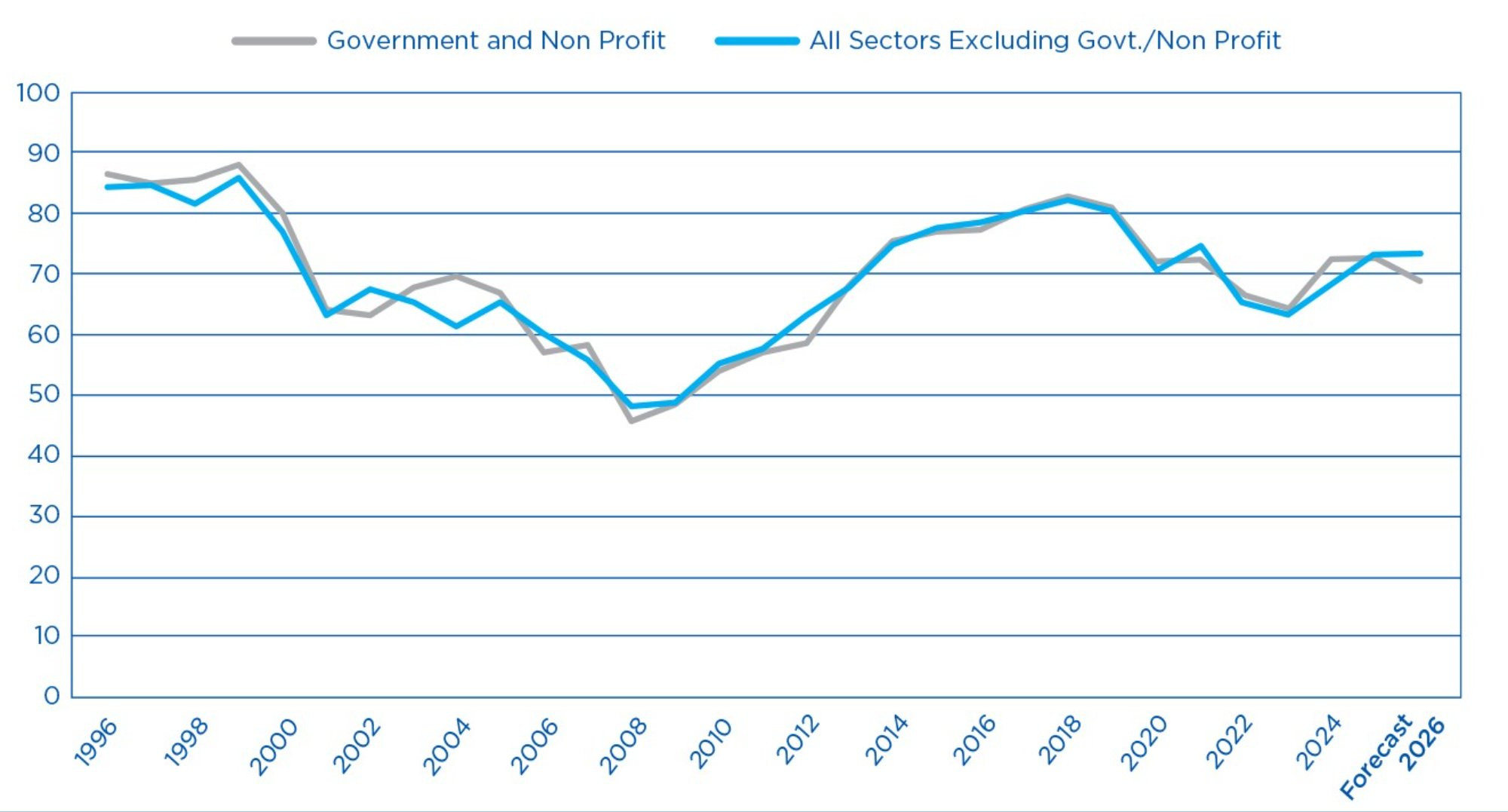
Description: The line graph depicts the West Michigan Confidence Index broken out by Government and Non-Profit and by All Sectors Excluding Government and Non-Profit responses. Data shown is from 1995 to the 2026 forecast.
Source: West Michigan Confidence Index Survey, administered in December, 2025.
The Confidence Index overall did not change much. However, the confidence for the coming year for the private sector is expected to stay steady while the government and nonprofit sectors are exhibiting a drop in expectations from 2025, although their confidence is still relatively strong. This is consistent with the change in the federal grants landscape that influences the non-profit sector. The private sector is showing that they feel 2026 will be similar to 2025.
Employment
Last year employment for KOMA grew 0.5% between September 2024 and September 2025. This was half the rate businesses indicated wanting to hire at the beginning of the year. During the year business uncertainty caused a slowdown in hiring as firms tried to minimize their costs until the uncertainty resolved. However, that uncertainty has not resolved.
The responses to the question: What percent change do you expect in employment for the four counties in 2026? are shown in Figure 2.
Figure 2: Employment Growth Outlook (2024-2026): Projected Workforce Expansion Trends
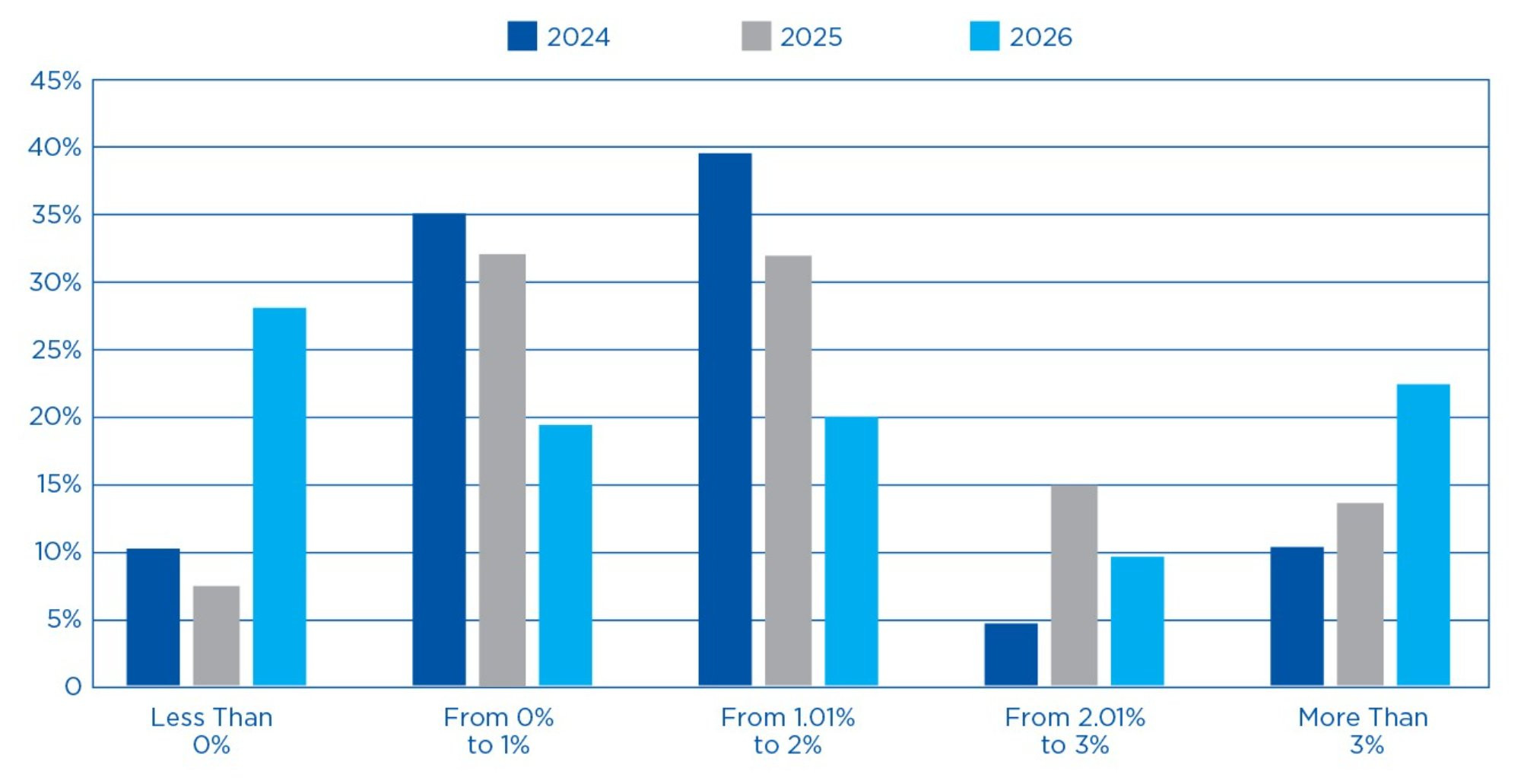
Description: The bar chart shows the percentage of survey respondents by their projected change in employment for the years 2024, 2025, and 2026.
Source: West Michigan Confidence Index Survey, administered in December, 2025.
Average employment in the KOMA region during 2026 is expected to continue to grow at a slow pace (0.2%), provided there are enough people willing to work. The big change is that 28% of respondents this year expect employment to shrink. This is even more concerning because larger firms are projecting slower employment growth than smaller firms. Interestingly, there was also a change in firms expecting employment to grow faster than 3%. This is consistent with the uneven growth we are seeing between different types of firms.
This year we also asked about wages. The average increase in wages is expected to continue to grow this year, at a similar pace to last year. The wage increase will improve slightly to 3.5% from increases of 3.2% in 2025. The wage growth has stabilized to increases that are more consistent with pre-COVID numbers with the most common expectation across all surveys of 3%.
Sales
For sales, the respondents answer the following question: What percent change in sales do you project for the four counties in 2026? As a reference point, during the late 1990s, sales grew at an annual rate of 5%.
During 2026 our respondents expect growth to be around 3.2% for the year which is similar to last year as shown in Figure 3. What is notable is that sales continue to outpace employment growth. This means that firms are expecting an increase in productivity for their workers over the year. This is consistent with increasing use of automation and AI in their businesses as indicated in Table 1.
Figure 3: Projected Sales Growth (2024-2026): Trends and Year-over-Year Comparisons
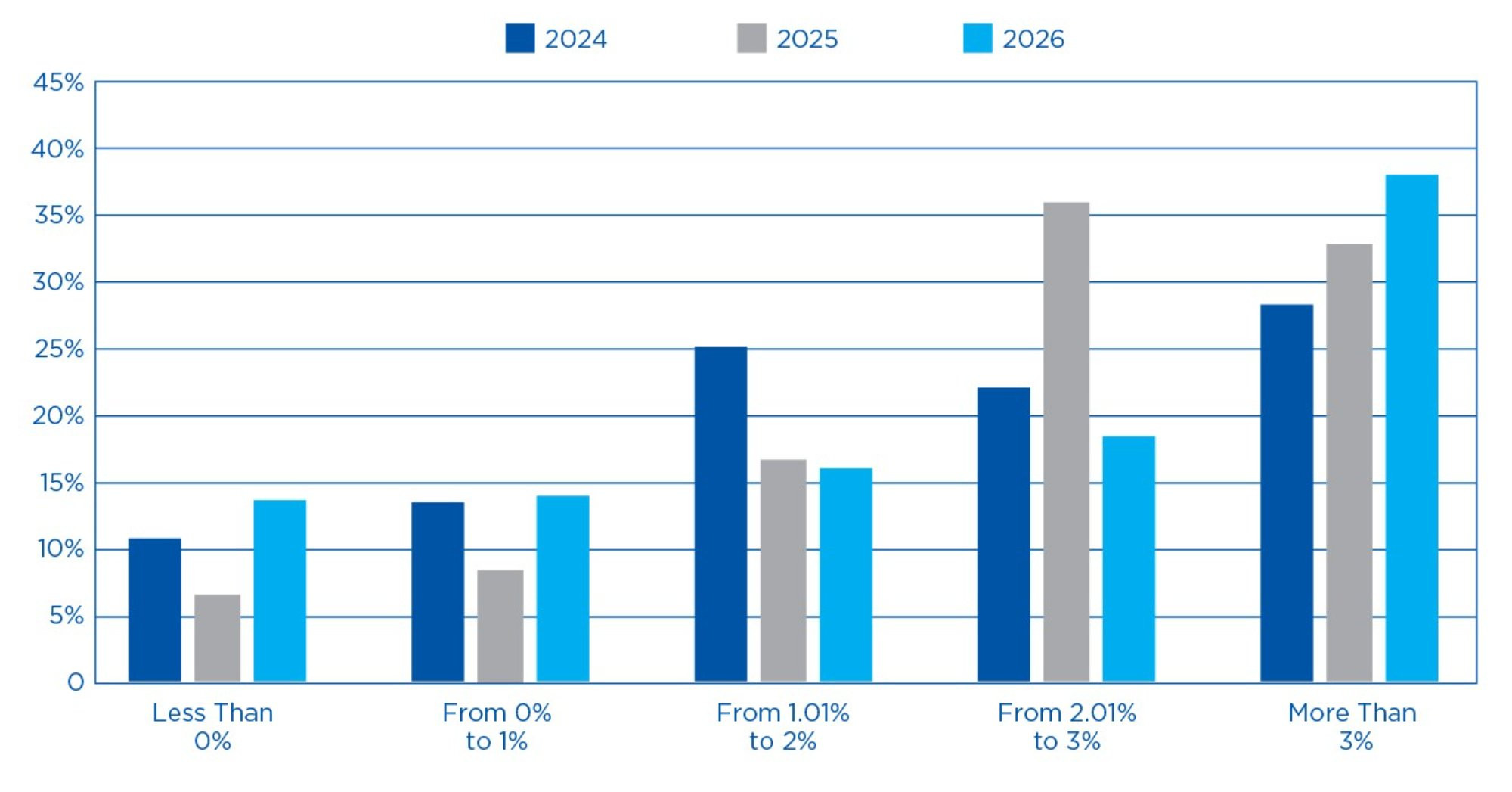
Description: The bar chart shows the expected sales growth for 2024, 2025, and 2026 by percent responding at different levels of growth as reported by Confidence Index survey respondents.
Source: West Michigan Confidence Index Survey, administered in December, 2025.
Table 1: Increasing Use of Automation and AI in Businesses
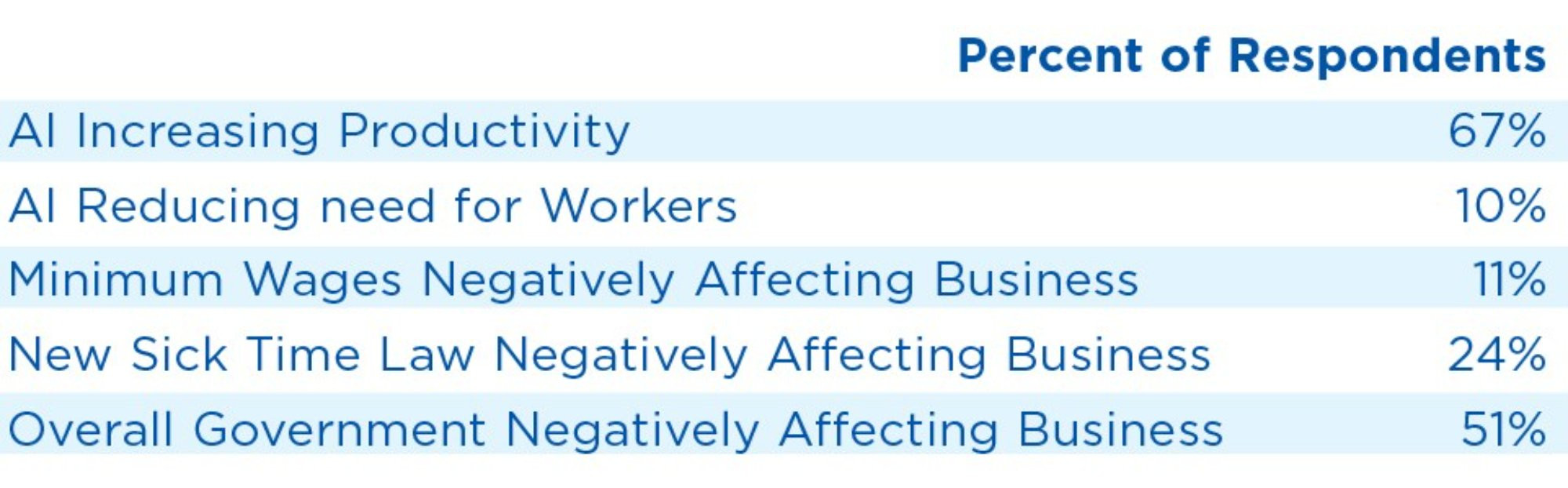
Description: The table shows the percent of Confidence Index Survey respondents indicating whether a range of topics from AI to minimum wages, new sick time laws, and government overall were negatively impacting their business.
Source: West Michigan Confidence Index Survey, administered in December, 2025.
The major change in expectations for 2026 compared to 2025 is that the percentage of firms expecting sales growth above 3% has increased to 38%. Firms are expected to grow with 82% of firms expecting to grow more than 1%. Notably, there is also an increase in firms expecting a decrease in sales (14%). This further reinforces the hot and cold nature of the economy expected for 2026.
Impact on Business
Two things came out in this year’s survey. First, firms are starting to use AI to improve their productivity, but only 10% are using AI to reduce headcount at this time. Second, the government was part of the reason for the hot and cold nature of the economy with 51% of the respondents saying government actions are negatively affecting their businesses.
General Outlook
The data for West Michigan shows employment continues to grow slowly. However, sales are expected to grow faster than last year. The continuing concern going into 2026 is that the excess savings for consumers has been used up, and now consumption is increasingly debt driven. Reinforcing a mixed experience, the West Michigan economy is showing both increases in firms expecting strong growth but also firms expecting to slow.
Acknowledgments
We are very grateful to all the organizations that participated in the survey. In addition, the assistance of Kayla Grabau-Baer and Christopher Khajira in the Seidman College Dean’s Office is appreciated.

Paul Isely, Ph.D., Associate Dean and Professor of Economics, Seidman College of Business